



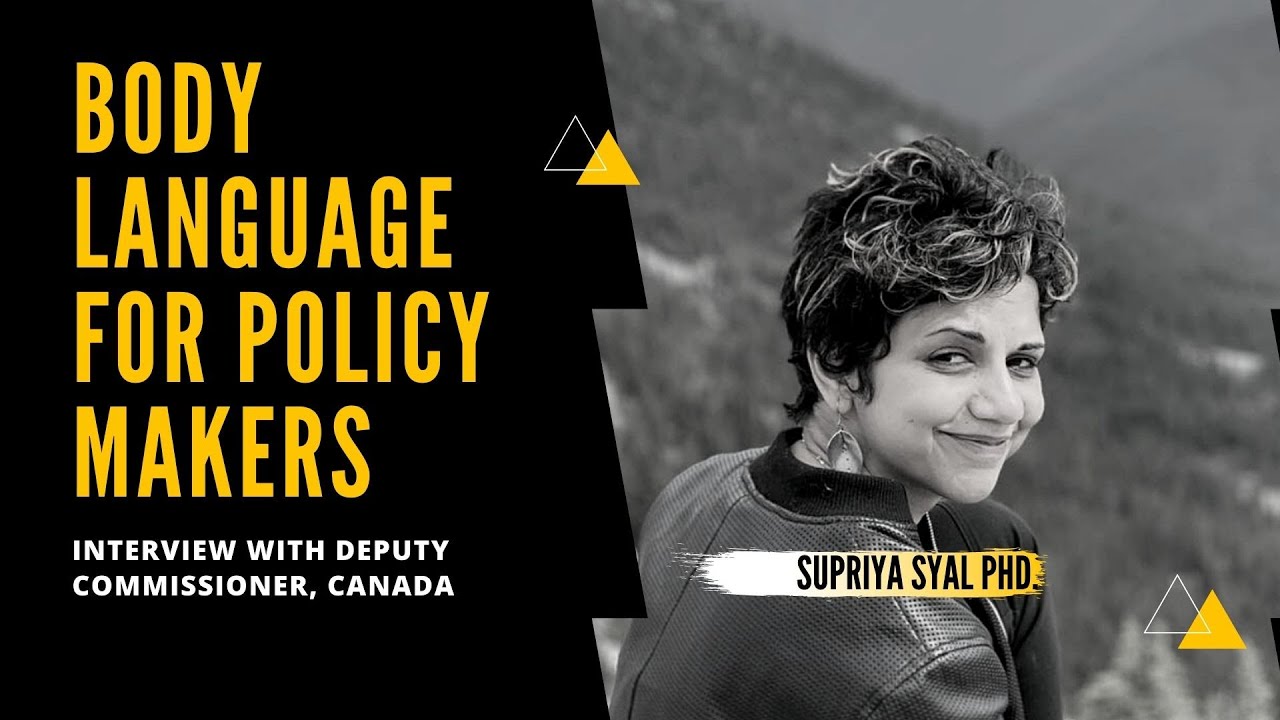
Deputy Commissioner in the FCAC Discusses the importance of body language!
MEET OUR NONVERBAL CHAMPION DR. SUPRIYA SYAL
Watch our video where Dr Supriya Syal discusses very interesting body language tips on:
ABOUT DR. SUPRIYA SYAL
Dr. Supriya Syal, Deputy Commissioner, Research, Policy and Education, Financial Consumer Agency of Canada, at the Chartered Professional Accountants of Canada’s Financial Literacy Virtual World Tour, November 2020.
VIEW INTERVIEW VIDEO
ABOUT INTERVIEW SERIES
Simply Body Talk salutes experts who understand the essence of nonverbal communication in taking their professional expertise to a different level. Watch more Expert interviews here
HOW WE CAN HELP
Enhance your teaching impact with our tailored programs focused on improving non-verbal communication. Learn to build stronger connections with students, manage classrooms effectively, and boost student engagement. If you are looking to upgrade your body language skills, check out our online pre recorded courses on various topics that come with lifetime access. You can also explore our Signature Body Language Personal Coaching program Reach out to us on – 99309 41534.
FAQ’s
Why does nonverbal communication matter more at senior leadership levels?
At senior levels, messages are rarely judged on content alone. Body language signals confidence, credibility, and intent, often shaping how decisions and authority are received before words are processed.
How does behavioural context change the meaning of body language?
Nonverbal cues are interpreted through situational, cultural, and power lenses. The same gesture can signal openness in one context and dominance or disengagement in another, making behavioural awareness critical.
Can leaders rely on intuition when reading nonverbal signals?
Intuition plays a role, but it is unreliable without structured observation. Effective leaders distinguish between personal bias and observable behavioural patterns before drawing conclusions.
What role does nonverbal communication play when language is a barrier?
When verbal understanding is limited, posture, gesture, eye behaviour, and spatial awareness often carry the primary meaning, shaping trust and cooperation in cross-cultural or regulatory environments.
How can HR teams assess nonverbal competence in leadership roles?
Assessment requires observing leaders across varied interactions, not isolated presentations. Consistency, adaptability, and behavioural congruence matter more than polished performance.