



Grooming Tips For Actors
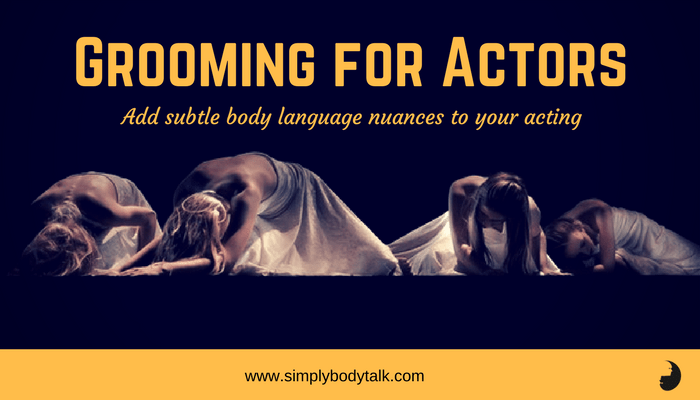
Grooming Tips For Actors
New entrants into the field of acting require a bit of polishing, be it on their personal body language front, or learning nuances to distinguish one mood or emotion from the other while acting on the stage or in front of the camera. Personalized grooming is available for all actors and aspirants, and the following are the basic guidelines of this one on one coaching service:
- Introduction to body language
- Basics of body language in daily interaction
- Confidence during auditions
- Recording personal body language
- Discussion of areas of improvement
- Understanding emotions and facial expressions
- Learning deliberate body language tactics like dominance, aggression, deception, attraction
- Voice modulation
- Practising deliberate tactics
- Practising with a holistic approach
- Practice for public speaking – exercises and rehearsal
- Interviews – basics and practice
- Improving command over English – basics and exercises
- Maintaining personal dressing style
If you require further clarification or details on personalized grooming, you can always fix up an appointment with us to understand how this works. Email us on contact@simplybodytalk.com or simply fill the form on the Contact Us page.
*Image courtsey: https://www.freepik.com/
REFRERNCES
I am text block. Click edit button to change this text. Lorem ipsum dolor sit amet, consectetur adipiscing elit. Ut elit tellus, luctus nec ullamcorper mattis, pulvinar dapibus leo.
HOW WE CAN HELP
Enhance your teaching impact with our tailored programs focused on improving non-verbal communication. Learn to build stronger connections with students, manage classrooms effectively, and boost student engagement. If you are looking to upgrade your body language skills, check out our online pre recorded courses on various topics that come with lifetime access. You can also explore our Signature Body Language Personal Coaching program Reach out to us on – 99309 41534.
FAQ’s
Why is body language training relevant for senior leaders, not just performers?
Body language is not limited to performance contexts; it shapes how intent, authority, and credibility are perceived. For senior leaders, subtle nonverbal signals often carry more weight than verbal content. Training builds awareness of these signals and reduces unintentional contradictions between message and behaviour.
What does “deliberate body language” mean in a leadership context?
Deliberate body language refers to the conscious use of posture, gestures, and expressions to reinforce a specific intent. In leadership, this may involve projecting confidence during uncertainty or neutrality during conflict. It is less about acting and more about controlled behavioural alignment.
How does recording and reviewing behaviour improve leadership effectiveness?
Most behavioural patterns operate below conscious awareness. Recording interactions allows leaders to observe themselves objectively, identifying inconsistencies or habitual signals. This creates a feedback loop where small adjustments can be tested and refined over time.
Can emotional expression be systematically developed, or is it purely instinctive?
While emotional responses are instinctive, their outward expression can be refined. Leaders often need to regulate how emotions are displayed to maintain clarity and stability in communication. Structured practice helps distinguish between authentic expression and uncontrolled leakage.
What role does voice modulation play in nonverbal communication?
Voice is a critical nonverbal channel that conveys confidence, authority, and intent. Variations in tone, pace, and emphasis can either reinforce or dilute a message. Leaders who develop vocal control tend to communicate with greater precision and impact.