



Modi Obama Hug – How A Hug Can Tell A Story

If you want to catch an extraordinarily awkward Zuckerberg and Modi hug widely published, try this With more than 50k likes on Facebook, this pose makes for all that a hug is not supposed to be! Zuckerberg is caught in a properly awkward pose, his jutting out hips, stiff legs and the outwards head tilt trying to compensate for the intrusion of his personal space by our very own hug lover leader. I am sure you can also see the forced smile on his face!
One tip for our Prime Minister – As powerful and effective as a hug can be in gaining favor and acceptance in interpersonal effectiveness with others, however, it can also be seen by some as an unwanted intrusion of their personal space. – Joe Navarro, What every Body is saying
A warm and proper hug is normally reserved for those dear and near to us, because we allow them to enter our personal space and touch us when we have let down all our defenses and exposed our ventral side. While this is a normal practice in informal situations, especially the U.S., Mr. Modi has been caught on screen in a lot of instances sharing this hug with policians, both on our home ground and internationally. More often than not, you will see the other party trying to awkwardly fit into the hug for the perfect picture pose.
So what about the wildly ridiculed hugs that Obama and Modi have shared in public? When Obama visited India 8 months ago, Modi had broken protocol by having gone out of his way to receive Obama right as he stepped out of his airbus. The video footage of that moment shows how Obama tried to reciprocate the warmth shown by Modi by hugging him in a style Modi knows only too well.

Body language plays a crucial role in establishing rapport, and the very instant they hugged, they started patting each other’s back, which is normally a sign of wanting to release the counterpart. You can also catch a slightly tensed look on Obama’s face, indicated by the furrowing of his brows.
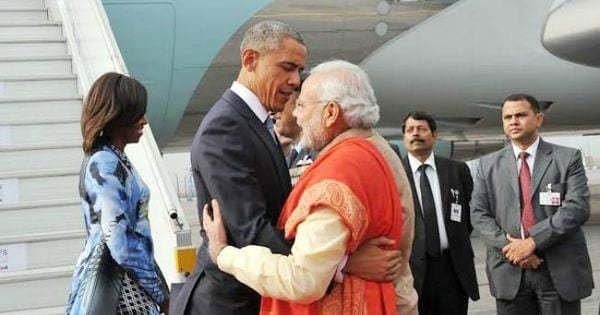
Modi is trying to end the “hug” moment by touching Obama on his elbow, normally done as a sign of reassurance. In the picture below, which is clicked during the same Obama visit but on a later day, you can see the leaders slightly more comfortable in the hug.

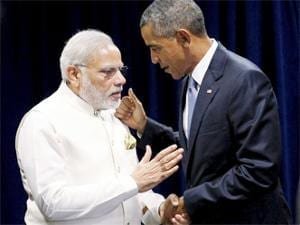
Obama’s posture still appears a bit stiff, with the distance between their feet trying to compensate for the closeness shared by their torsos. Below are pictures clicked when the two leaders met a few days back at the U.N.

Obama’s closed eyes in the pic speak of resignation to the pose, or acceptance, whichever it may be. Closed eyes are generally a sign of someone trying to be “in the moment”. Shutting off the vision allows him to concentrate more on his other senses. At the next level of rapport, you would probably see Obama’s face leaned in slightly more, showing more involvement.

Here, from this angle you can see that Obama’s stance is definitely more relaxed than before, as is the frown on his furrowed forehead, which is less visible than in his visit to India. We would ideally like the slight pursing of his lips, which again suggest slight apprehension, to disappear, for the embrace to look natural.

This pose, which is not that of hugging, is still crucial in understanding the chemistry shared by Modi and Obama. When individuals, especially leaders, share increased frequency of physical contact, it signals a rapport in the building. Does this signal good times ahead for India and US? Only time will tell. But it sure does tell us that the leaders have started feeling relaxed in each others’ company. It is easy to guess how good a chemistry individuals share and whether they are total strangers, good acquaintances or fast friends, depending on the tension on their faces, the ease of postures and distance between their bodies. The next step to good rapport is mirroring. (To see how effective real world mirroring is, read Amazing Mirroring Display by Nargis Fakhri and Frieda Pinto) We hope to catch that among these two some day!
Written by,
Khyati Bhatt
HOW WE CAN HELP
Enhance your teaching impact with our tailored programs focused on improving non-verbal communication. Learn to build stronger connections with students, manage classrooms effectively, and boost student engagement. If you are looking to upgrade your body language skills, check out our online pre recorded courses on various topics that come with lifetime access. You can also explore our Signature Body Language Personal Coaching program Reach out to us on – 99309 41534.
FAQ’s
What does a hug communicate in a leadership or diplomatic context?
A hug, in leadership settings, is not merely warmth it is a signal of intent, control, and relational positioning. It can communicate openness and trust, but equally, it can impose proximity that the other party may not be prepared for. The interpretation depends less on the act itself and more on how it is received.
How can leaders identify discomfort in physical interactions like a hug?
Discomfort often reveals itself through compensatory behaviours stiff posture, increased distance between lower body positions, forced facial expressions, or quick exit signals like back-patting. These are not overt rejections, but subtle attempts to regain personal boundaries.
Why is personal space critical in executive-level interactions?
Personal space reflects psychological safety and control. When it is breached without mutual readiness, it can shift the interaction from collaborative to defensive. For leaders, misjudging this boundary can unintentionally create resistance rather than rapport.
What role do micro-behaviours play in assessing rapport between leaders?
Micro-behaviours such as facial tension, eye closure, body alignment, and touch duration offer more reliable insight than overt gestures. They reveal whether the interaction is naturally aligned or being managed for optics, which is especially relevant in high-visibility leadership moments.
How does rapport evolve through nonverbal behaviour over repeated interactions?
Rapport is not established in a single gesture but through consistency and gradual behavioural alignment. Over time, reduced tension, increased ease in posture, and the emergence of mirroring indicate a shift from formality to genuine comfort.