



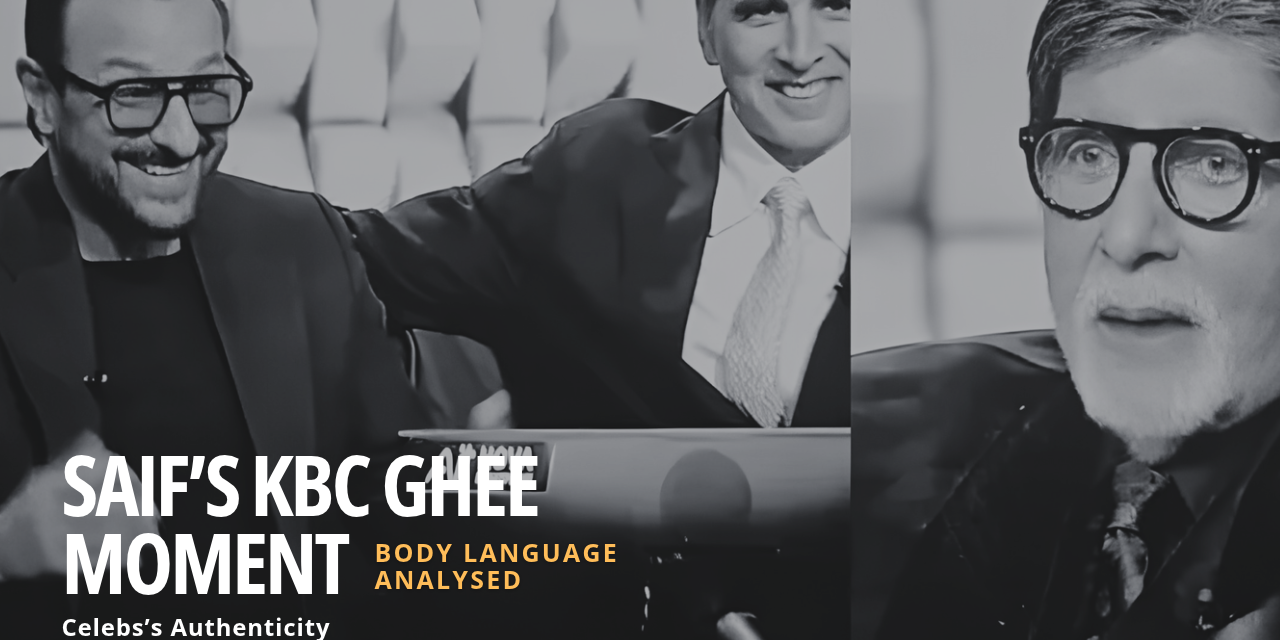
Understanding genuine excitement, social behaviour and the subtle differences between what we feel and what we display.
Who would have thought that a two-year supply of ghee could get Saif Ali Khan so excited? When Amitabh Bachchan announced the possibility of winning two years’ worth of ghee on Kaun Banega Crorepati, Saif’s reaction was quite something. His “Wow, what?” followed by “This is it, this is why I came” had Akshay Kumar laughing and the internet busy creating memes.
It wasn’t just Saif’s reaction that made the moment entertaining. It was the contrast between his excitement, Akshay’s amusement and Amitabh Bachchan’s rather composed delivery of the announcement. And that makes this a rather interesting moment to study from the perspective of body language.
We often associate celebrities with expensive holidays, luxury cars and extravagant lifestyles. Yet, when they speak about something as ordinary as ghee, French fries or a favourite biscuit, we get a glimpse of a side that feels much more familiar. Alia Bhatt’s fondness for French fries, Vidya Balan’s love for Jim-Jam biscuits at five-star hotel cafés and Salman Khan’s chocolate-for-breakfast habit, as recounted by Karisma Kapoor, are all examples of how everyday indulgences can make celebrities seem more relatable.
But what does their body language tell us when they talk about these little pleasures? And how do we distinguish genuine excitement from a reaction that is being played up for the cameras?
Let’s look at some interesting aspects of nonverbal communication.
1. Your Reaction Depends on Your Relationship With What Is Being Discussed
The way we react to a subject often has more to do with our relationship with it than with the subject itself. For instance, if someone has overcome an issue or has become comfortable discussing it openly, they are likely to speak about it naturally. You may not notice any significant change in their voice or body language when the topic comes up. On the other hand, if the same subject is something they are still struggling with, their reaction could be very different.
The same applies to celebrities. When Alia Bhatt speaks comfortably about being called Aloo, for instance, her ease in discussing it tells us something about her relationship with the subject. It doesn’t necessarily reveal a particular personality trait; it tells us that she is comfortable with this aspect of herself.
The person they are interacting with also makes a difference. When Salman Khan shares his chocolate-related habits with Karisma Kapoor, the familiarity between them could make him more comfortable sharing additional details. When we are speaking to someone we trust or someone we know is on our side, we tend to be less watchful about how we are coming across. Our gestures flow more naturally, and we don’t feel the need to monitor every reaction.
Of course, there are times when we deliberately display a little more excitement because we know that is what the situation calls for. And sometimes, the excitement is entirely genuine. The interesting part is learning to observe the difference.
2. How Can You Tell If Excitement Is Genuine or Being Played Up?
One of the things I often tell people when teaching them to read body language is that you should never study an expression in isolation. You need to observe what happens before, during and after the reaction.
When someone is genuinely excited, their expressions and gestures tend to emerge naturally and are usually in sync with what they are saying. However, when someone is consciously putting on a display, there may be small differences in timing, duration or coordination.
For instance, a smile that stays on the face much longer than the situation warrants could be worth observing. Similarly, if the reaction comes a little too quickly, or appears slightly delayed, it may indicate that the person is consciously managing their response. These differences can be extremely subtle, particularly when you are observing seasoned actors who are naturally skilled at controlling their expressions.
Gestures can offer additional information. When someone becomes genuinely excited, their hand movements may become more animated. However, if they suddenly become aware that their reaction is being watched, they may start controlling their gestures or become a little more stiff. This is why comparing their behaviour a few seconds before the moment is so important.
Voice is another element to consider. Excitement can result in a higher-pitched voice, faster speech or greater vocal variation. However, stress can produce similar changes, so voice alone cannot tell us whether someone is genuinely happy or simply performing for the audience.
It is the combination of facial expressions, gestures, vocal changes and their timing that gives us a stronger understanding of what might be happening.
3. When One Person's Reaction Influences Another
This is perhaps one of the most interesting aspects of the Saif Ali Khan moment.
Nonverbal communication is a two-way process. We don’t just display our emotions; we also respond to the reactions of people around us. Sometimes, the other person’s attempt to control their own expression can influence how we behave.
Look at Amitabh Bachchan during the ghee announcement. He appears to be maintaining a remarkably straight face, almost holding back a smile while delivering the news. His expression is more controlled than one might expect in a light-hearted exchange of this nature.
Now observe Saif. His smile and nodding begin even before the announcement is completely over. The reaction continues through his verbal response, and his body appears to sustain the excitement for longer than the announcement itself would ordinarily warrant.
My reading of this particular interaction is that there is an element of performance in Saif’s reaction. The nodding starts very early, and the timing of his enthusiastic “Wow” and the accompanying fist gesture does not appear entirely synchronised.
There is another interesting moment when Akshay Kumar looks towards Saif, clearly amused by the announcement. His expression suggests that he is enjoying the situation, perhaps expecting Saif to share in the amusement. Saif, however, appears to be displaying a much more enthusiastic response. When Akshay doesn’t quite match that level of excitement, Saif is seen tugging at his trousers after saying “What”. This could be a self-comforting gesture, often referred to as a pacifier, which may appear when someone becomes a little self-conscious or watchful.
Of course, a gesture like this cannot establish what someone is feeling. But when you look at the entire interaction, including the timing of expressions and the reactions of the other people involved, it makes for an interesting observation.
4. Why Do Actors Sometimes Look More Excited About Simple Things Than Expensive Gifts?
There isn’t one definite explanation for this. Sometimes, celebrities may consciously highlight their enjoyment of ordinary things because it helps audiences see them as more grounded. At other times, the excitement could be completely spontaneous.
There is also a psychological aspect worth considering. We tend to become less excited about things that we experience regularly. Someone who is accustomed to receiving expensive gifts may not display the same surprise or enthusiasm as someone receiving something unexpected or unusual.
This is related to the economic principle of diminishing marginal utility, where the additional satisfaction derived from consuming something tends to decrease as its consumption increases. In simpler terms, the novelty of an experience can make a difference to how excited we feel about it.
And perhaps that is one reason why Saif’s ghee moment resonated with so many people. It was a rather ordinary thing to get excited about, and that made the reaction entertaining and relatable.
5. Why Do We Find Celebrities More Relatable When They Reveal Their Quirky Side?
There is something interesting about the way we respond when celebrities share little personal details that have nothing to do with their professional lives. It gives us a peek into their world, almost as though we have been allowed to step into their personal space for a moment.
From a body language perspective, what makes this interaction more engaging is the comfort with which they share these details. When someone speaks naturally, without appearing overly watchful or stiff, the audience tends to perceive them as being more comfortable with what they are revealing.
You may notice a relaxed facial expression, natural gestures and an absence of excessive self-comforting movements such as repeatedly adjusting jewellery or fiddling with accessories. On the other hand, a tight jaw, a fixed smile or a body that appears unusually restrained may suggest that the person is monitoring how they are coming across.
This doesn’t mean that someone who fidgets is necessarily uncomfortable or hiding something. The important thing is to observe whether their behaviour changes when the conversation moves into more personal territory.
Perhaps the reason these moments connect with us is quite simple. We all have our little indulgences, habits and quirks. Seeing a celebrity openly share theirs reminds us that, beyond the fame and glamour, they are not very different from the rest of us.
A Word of Caution When Reading Celebrity Body Language
While celebrity interactions make for excellent opportunities to understand nonverbal communication, there is one thing we must remember: body language cannot tell us exactly why someone behaved in a particular way.
Was Saif genuinely excited, consciously playing up the moment for entertainment, or simply enjoying the exchange with Amitabh Bachchan and Akshay Kumar? We cannot establish that from a short video clip alone.
What we can do is observe the changes in his expressions, the timing of his gestures, the way his voice changes and how the other people respond to him. These observations help us form an interpretation, but they should not be mistaken for proof of someone’s thoughts or intentions.
And that is the real art of reading body language. It isn’t about jumping to conclusions based on one gesture or expression. It is about observing multiple signals, understanding the context and looking at how people respond to one another.
At Simply Body Talk, we believe that everyday interactions offer some of the best opportunities to understand nonverbal communication. You don’t always need a formal interview or a business meeting to observe human behaviour. Sometimes, all it takes is a celebrity getting excited about two years’ worth of ghee!