



How Colors Speak For World Leaders
Let’s see the secret of colour psychology known by the world leaders and how do they use it.
Colour plays a vitally important role in the world in which we live. Colour can sway thinking, change actions, and cause reactions. It can irritate or soothe your eyes, raise your blood pressure or suppress your appetite. When used in the right ways, colour can even save on energy consumption.
We have seen in a lot of world leaders that they are very particular about what they wear whenever they travel. A basic protocol that most of the world leaders follow is that they always wear black whenever they are travelling out of the country. This is because for formal wear, black is a colour that signifies power, strength, authority, elegance, authority and sophistication.
In the recent meeting between Imran Khan and Donald Trump, we saw something very interesting.
When Imran khan arrived in the United States of America, he was wearing a black outfit, as shown in the picture below.

Khan arrives in USA
This is his preferred choice whenever he is visiting a different country or when meeting other world leaders. Below are a few images of Imran Khan using the black color power to his advantage with different world leaders.
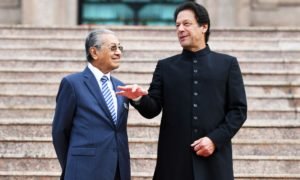 Khan meeting the Malaysian Prime Minister
 Khan meeting Crown Prince of Abu Dhabi
Coming back to the recent visit of Khan to USA, when Khan went to meet Trump at the White House, he didn’t wear a black outfit rather he chose to change into a navy blue outfit.
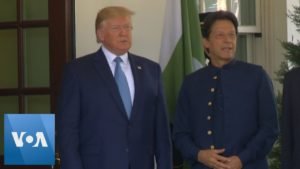 Official meeting of Khan and Trump
Navy blue is a colour which is often associated with depth and stability. It symbolizes trust, loyalty, wisdom, confidence, intelligence, faith, truth, and heaven.
So did Khan want to signal to Trump that he could be trusted? Remember, the leaders were meeting for the first time. Trump had initially critisized Pakistan on public forum and this meeting was an attempt from both sides to improve their nations’ relations.
Have you observed how other business leaders use the same style of clothing to send out specific nonverbal signals? Here is some food for thought. Below is a picture of Hillary Clinton during her concession speech post her Presidential election campaign against Trump. Notice the choice of color purple which is bright and unlike her usual clothing palette. Why did she choose this? What do you think?

Hillary Clinton concession speech
Image Courtsey: VOA News, Dawn Today’s paper, Time, Livemint
This lock down period, get exciting offers on our webinars to know more visit link here
HOW WE CAN HELP
Simply Body Talk helps individuals and leaders to sharpen their first impressions. You can explore our Personal Coaching Program or view our course Master Your First Impressions. You can also view our Free Webinar on First Impressions. To know more, you can request a callback or reach out to us on – 99309 41534.
FAQs
How does colour function as a nonverbal signal in leadership settings?
Colour operates as a fast, pre-verbal cue that shapes perception before words are processed. It can signal authority, stability, openness, or neutrality depending on context. Senior leaders often use colour deliberately to manage first impressions and emotional tone. These signals are subtle, but rarely accidental.
Why is black commonly associated with power and authority among leaders?
Black carries strong associations with control, formality, and decisiveness. In leadership contexts, it reduces visual noise and centres attention on status rather than personality. It is often chosen in unfamiliar or high-protocol environments to project composure and strength. The choice is more strategic than aesthetic.
What does a shift from black to navy blue typically communicate?
Navy blue softens authority by adding signals of trust, stability, and reliability. It is often used when leaders want to appear collaborative rather than dominant. In first-time or relationship-repair meetings, this shift can subtly reframe intent. The signal lies in contrast, not the colour alone.
Can clothing colour influence negotiation or relationship-building outcomes?
Yes, while not determinative, colour contributes to the emotional climate of an interaction. It can support or undermine verbal messaging, especially in high-stakes or first-encounter scenarios. Leaders who understand this manage perception more consciously. Those who don’t still signal just unintentionally.
How should senior leaders think about colour without overinterpreting it?
Colour should be read as part of a broader behavioural cluster, not in isolation. Context, relationship history, cultural norms, and accompanying nonverbal cues matter. The goal is not symbolism, but alignment between intent and perception. Observation precedes interpretation.