



Akshay’s Contradictory Displays
When someone displays contradictory signals, something suggesting they are ok while at the same time some body language showing their discomfort, which signals should you believe? Meaning, which body language is giving you an honest picture of how the person is feeling or thinking?
Here is the answer – trust the discomfort signals displayed by the body, because our limbic brain or the primitive brain is instinctively hardwired to react to situations which cause us any psychological discomfort. Simply put, when we face threat or uneasiness of any kind, we react to show our discomfort before even realising it.
Clearly Akshay Kumar was not very relaxed in his appearance with his wife Twinkle Khanna on the sets of Koffee with Karan season 5 last week. We saw a lot of forced smiles, tensed lips, etc. But in this particular picture what we see is an interesting display of contradictory signals
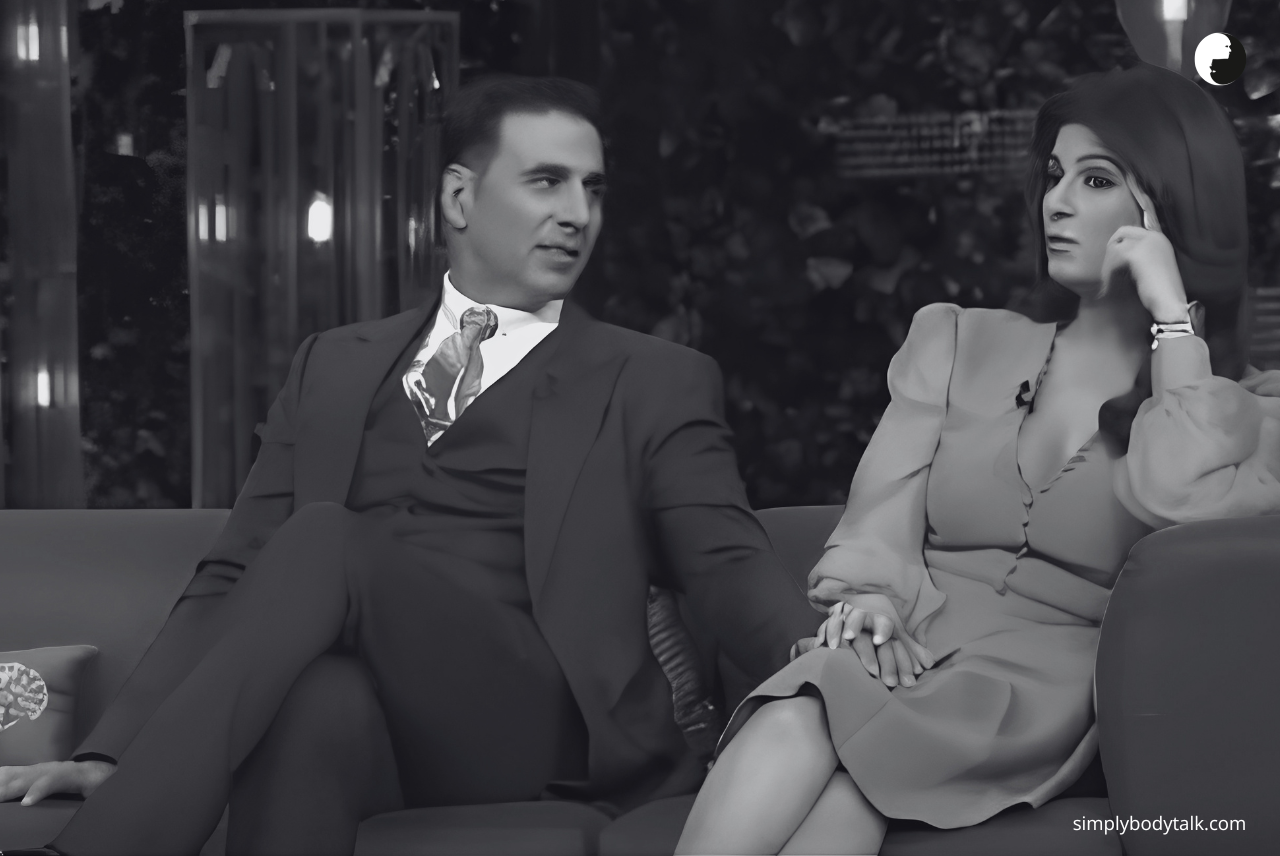
Here is a detailed analysis of the body language of Akshay Khanna with his spouse Twinkle Khanna on Koffee with Karan
Body language signals saying he is comfortable:
- He is smiling, which signals he is relaxed
- He is establishing direct eye contact towards Twinkle, which signals he is not shy or less confident
- He is holding her hand, where the touch is being used to signal trust in each other
Akshay’s body language suggesting he is not comfortable or relaxed:
- His torso is pointing away from Twinkle, which we do when we are not very comfortable in the company of someone. This is also called ventral blading which means not showing our entire torso to the person we are not comfortable around
- His legs are crossed away from her, which means he is not fully involved in the interaction
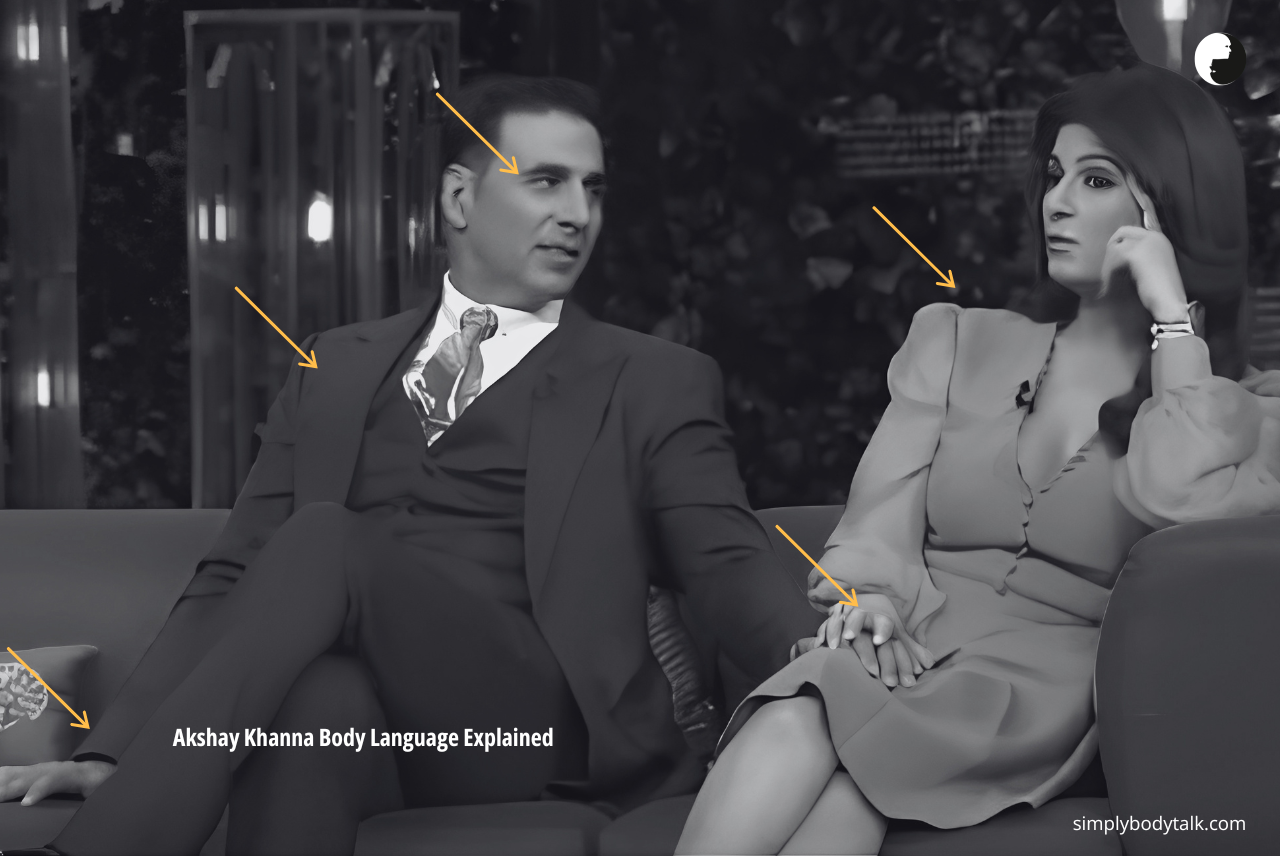
So reading the above picture in context, Akshay Khanna is trying, in the moment, to show his support for his spouse by holding her hand, and by eye contact showing that he does not feel under confident with what she just said. But his mind is still struggling to open up to the show, the host, or the question answer environment. Ideally, he would have uncrossed his legs, faced her, and then held her hand if the gesture was genuine.
It is never easy to guess why someone feels discomforted, but we do know from Akshay’s body language that he is not at ease.
Image courtesy: Mid-day
If you like body language, you will also like our online course which is a comprehensive starter package on various scenarios of body language. The course has lifetime access. Check out our preview video here.
HOW WE CAN HELP
Simply Body Talk works with celebrities and leaders who face media interviews and helps them prep for their verbal and nonverbal communication during moments of high stakes. Check out our Coaching Program. If you have an interest in understanding body language, you can take up our online courses with lifetime access and keep learning. To organise a body language focused workshop for your team, reach us at +91 99309 41534.
FAQ’s
1. What are contradictory signals in body language?
Contradictory signals occur when a person displays both comfort and discomfort cues simultaneously. For example, smiling or maintaining eye contact while the torso angles away or the legs withdraw from the interaction. In such moments, the body often reveals internal hesitation that the face is attempting to mask.
2. Which body language signals are more reliable: comfort cues or discomfort cues?
Discomfort signals tend to be more reliable because they are driven by the limbic system, the brain’s automatic response mechanism to perceived stress or unease. These reactions appear quickly and often before a person consciously regulates their behaviour. As a result, subtle withdrawal cues frequently carry more diagnostic value.
3. Why do people display supportive gestures while their body shows disengagement?
Humans often attempt to manage social impressions, especially in public or sensitive conversations. A person may display gestures of support such as touch or eye contact while their posture reveals lingering discomfort. This creates a temporary behavioural mismatch between intention and emotional state.
4. What does torso orientation reveal in interpersonal communication?
Torso orientation reflects where psychological engagement is directed. When someone turns their torso away from a person or situation, it can signal emotional distancing or unease. Conversely, facing someone squarely typically indicates openness and willingness to engage.
5. How can leaders interpret mixed nonverbal signals during conversations?
Leaders benefit from observing clusters of behaviours rather than isolated gestures. When multiple discomfort cues appear such as leg withdrawal, torso angling, or tightened facial expressions it may indicate hesitation, disagreement, or cognitive tension. Recognising these signals allows leaders to adjust the pace or direction of the conversation.







Legs crossed other way is a because tinu doesn’t want his shoes to spoil her dress !
Possible. But context and other clusters are always a clue. Look at how his body is tilted away from hers. Actually away from both of them. He knows they are childhood friends and expects them to chat about difficult topics with ease, which is possibly why he is on guard.
Interesting learning. However the interpretation seems specific to this picture. There are other pictures available where his torso is not away from her and what S said above.
Body language is always at any point in time. Because our thoughts, emotions and intentions keep changing and shifting, the same is reflected in our body language, sometimes large behaviours, sometimes subtle ones. Glad you could spot how he is oriented away from her in the picture we analyse together.