



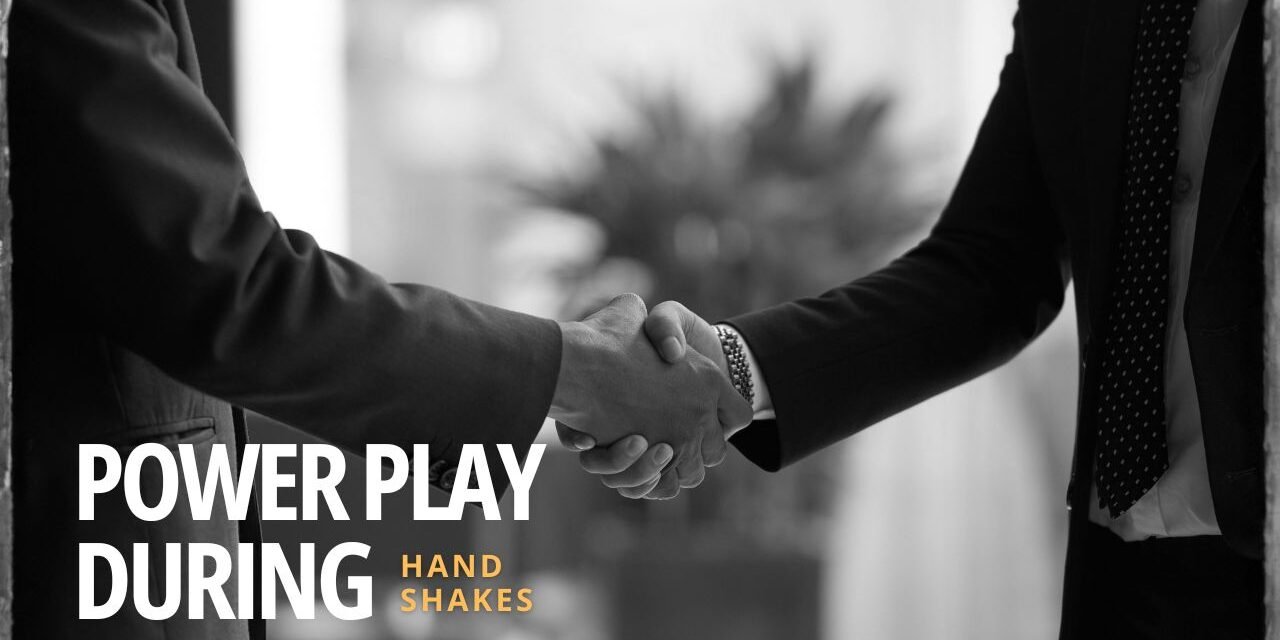
Power Plays During Handshakes
You would often see politicians pose in front of cameras while greeting each other with a handshake. You can observe all sorts of power struggles if you watch these few seconds of cameras clicking closely. Right from who stands on the left side of the picture frame to offering the double hander you can see it all on display.
LEFT SIDE ADVANTAGE
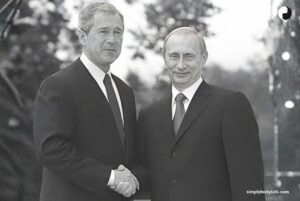
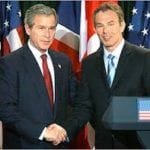
The one on the left side of the camera usually gets to put his hand in front of the camera thus appearing to have the dominant upper hand.
Former American President George Bush is very famous for having mastered the left side advantage. (Read about how Indian Prime Minister Modi uses the left side as a strategy)

DOUBLE HANDER
When one party uses two hands to complete the hand shake instead of just one, the hand shake is typically called a Double Hander.
This type of hand shake can be used in two ways:
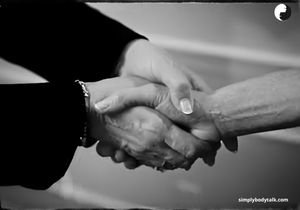
- To counter the dominant hand shake if used by the person on the submissive side. The person on the right side of the frame might try to counter the advantage gained by the other politician by placing his other hand on top of the handshake, thus establishing that he indeed has the upper hand advantage.
- It can be used by the hand shake initiator to show trust and warmth on his behalf. In this case, the higher up the arm that the initiator places his other hand, the more intimacy he tries to project.
The double hander is typically nicknamed the politician’s handshake and for very evident reasons. It is best to avoid this type of handshake in a formal setting as it is representative of a hug and can be taken offensively, especially by females. Offer a double-hander only in cases where a hug would also be acceptable.
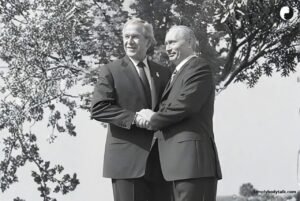
In this picture you can see Mr. Putin countering Mr. Bush’s dominant handshake using a double hander.
COUNTERING DOMINANT HANDSHAKE
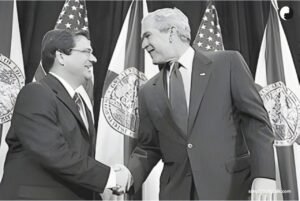
Another way to counter the offer of a dominant hand shake is to step forward putting your left foot forward. Next bring your right foot in front of the person so that you step into his personal space. This will force him to move back a bit and loosen his grip on the handshake thus giving you a chance to turn your hand over. You can turn the Hand Shakes into a neutral one or a dominant one, depending on the point that you wish to make to the counter person. You can see Mr. Bush using this technique to bring the Hand Shakes on an equal footing in these pictures. (Also read how Indian leader Sushma Swaraj cleverly countered a dominant handshake)
HOW WE CAN HELP
In sales, the deal often starts before you say a word. The way you walk in, extend your hand, make eye contact, and hold yourself in those first few seconds sets the tone for everything that follows.
At Simply Body Talk, we work with sales professionals and managers through personalised coaching to help them master the art of the handshake, read client body language accurately, and use non-verbal communication to build trust and close with confidence.
Prefer to learn on the go? We have body language secrets to close the sales now available on eClass so your entire sales team can upskill anytime, anywhere.
If you’re ready to give your team a edge that shows, book a consultation or reach out directly on +91 99309 41534.
FAQ’s
What does a handshake reveal about leadership power dynamics?
A handshake often reflects an immediate negotiation of control, even before words are exchanged. Elements such as hand position, grip orientation, and body placement signal dominance, equality, or submission. For leaders, these cues influence perception at a pre-verbal level, shaping how authority is received in the first few seconds.
Why is positioning during a handshake important in executive settings?
Positioning such as who occupies visual foreground or spatial advantage affects perceived control. Being on the visually dominant side, or initiating movement, subtly frames the interaction. These decisions are rarely accidental in high-level environments and often reflect strategic intent rather than habit.
Is the “double hander” handshake appropriate in professional contexts?
The double hander introduces an additional layer of perceived intimacy, often interpreted as an attempt to accelerate trust. In formal or unfamiliar settings, it can feel intrusive or disproportionate to the relationship. Its effectiveness depends less on intent and more on contextual appropriateness and relational depth.
How can leaders respond to a dominant handshake without appearing aggressive?
Effective responses rely on subtle physical adjustments rather than overt resistance. Shifting body position, stepping forward, or adjusting hand orientation can neutralise imbalance without escalating tension. The objective is not to overpower, but to restore equilibrium while maintaining composure.
Can nonverbal gestures like handshakes be consciously trained?
Yes, but not in isolation. While individual techniques can be learned, their impact depends on timing, context, and behavioural consistency. Training typically focuses on awareness recognising patterns, interpreting intent, and responding with calibrated adjustments rather than rehearsed reactions.