



BEST TYPES OF HANDSHAKES
A handshake is perhaps the first sign of communication when a person meets one on one. The way you shake your hands says a lot about who you are and in what frame of mind you are about to attend the meeting. Handshakes are used commonly in informal settings when a meeting is about to begin or end, or as part of an introductory round, crucial for leadership and workplace dynamics. While there is one right and apt way to shake hands, most of us end us shaking hands depending on what state of mind we are in, or how we perceive the person at the other end to be, which is why there exist different types of handshakes.
A handshake is just the beginning.
Simply Body Talk trains corporate teams in the full science of nonverbal communication.
WHY THE HANDSHAKE
Handshakes date back to the cavemen who used to put up their hands when greeting each other to show hands-free of weapons, intending friendliness. Over time, the greeting signal changed to taking each other’s hand showing a warm welcome. A good handshake, as per research by social psychologists, can make you feel as good about the counterpart, as a nice warm hug can. That’s the power of a handshake! A body language enthusiast can spot several different types in what most of us conceive as a simple greeting gesture.
KNOW THE COMMON TYPES
Below are some of the commonly observed types of handshakes. The first one is the correct way of shaking hands, so be sure to read that one up well. The rest will help you to understand other well and correct your handshake in case it is not proper.
1. THE FIRM HANDSHAKE
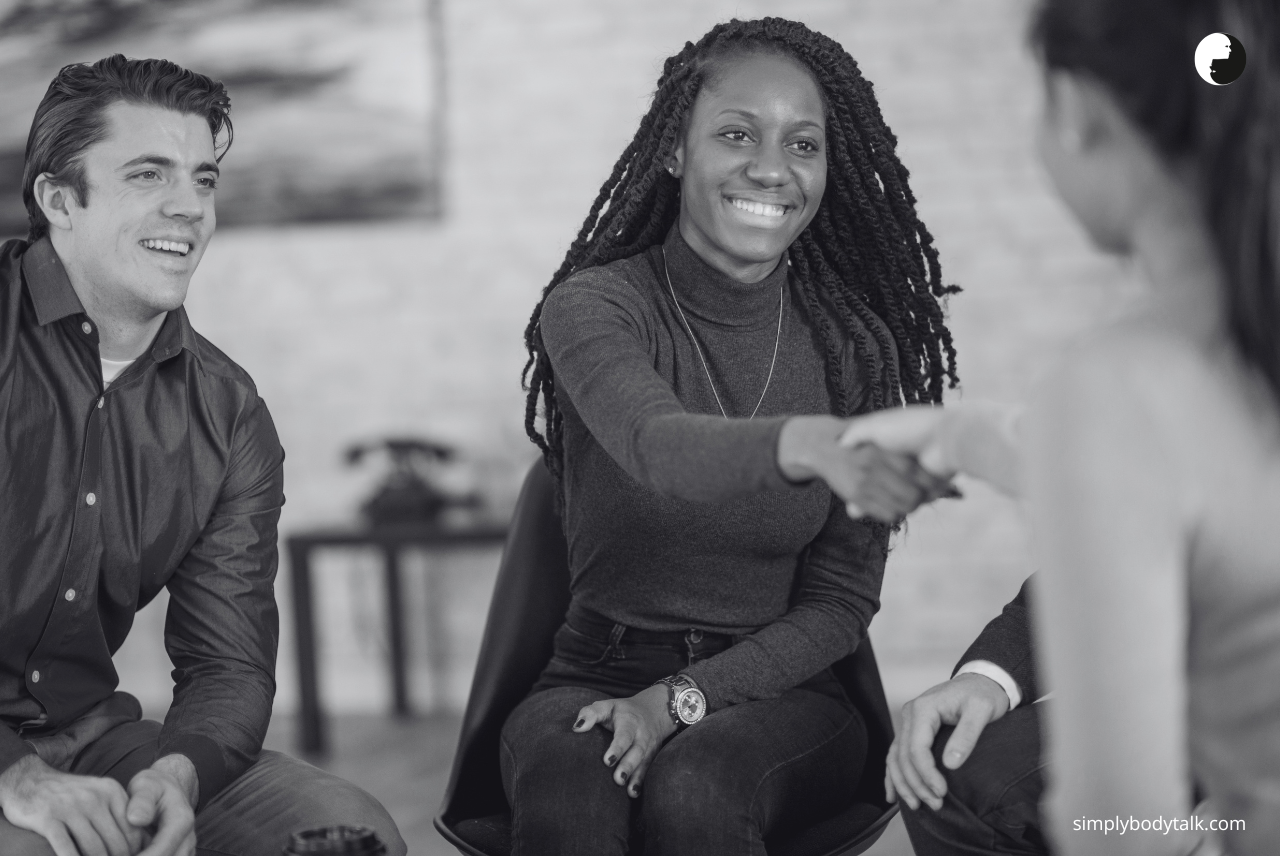
When both parties extend their hands and shake on an equal level with no one hand above the other, it is a firm and neutral handshake. This type of handshake is often seen in workplace settings, indicating equality and mutual respect in nonverbal communication. If you are unsure about the steps to get this firm handshake correct, read our article.
2. THE DOMINANT HANDSHAKE
When one person extends his hand by offering his palm down, either he is of a dominant personality by nature or is consciously trying to signal his intention of decision making in the forthcoming discussion or negotiation. These types of conscious dominant handshakes are most commonly seen in power struggles by politicians in front of the camera. The way to counter a dominant handshake is to hold the dominating person’s arm while shaking his hand. This can be a key aspect in leadership scenarios.
3. THE SUBMISSIVE HANDSHAKE
Responding to a palms-down dominating hand would be a submissive hand, indicating an easy-going or submissive personality. It indicates to the counterparty your willingness to give in to demands across the table. Also, the handshake should be firm. If you offer your hand too softly, it indicates submissiveness. Understanding these cues is vital in workplace interactions and leadership roles.
Ready to read people, not just hands?
Get a free consultation and find the right workshop for your team.
4. THE WET FISH HANDSHAKE
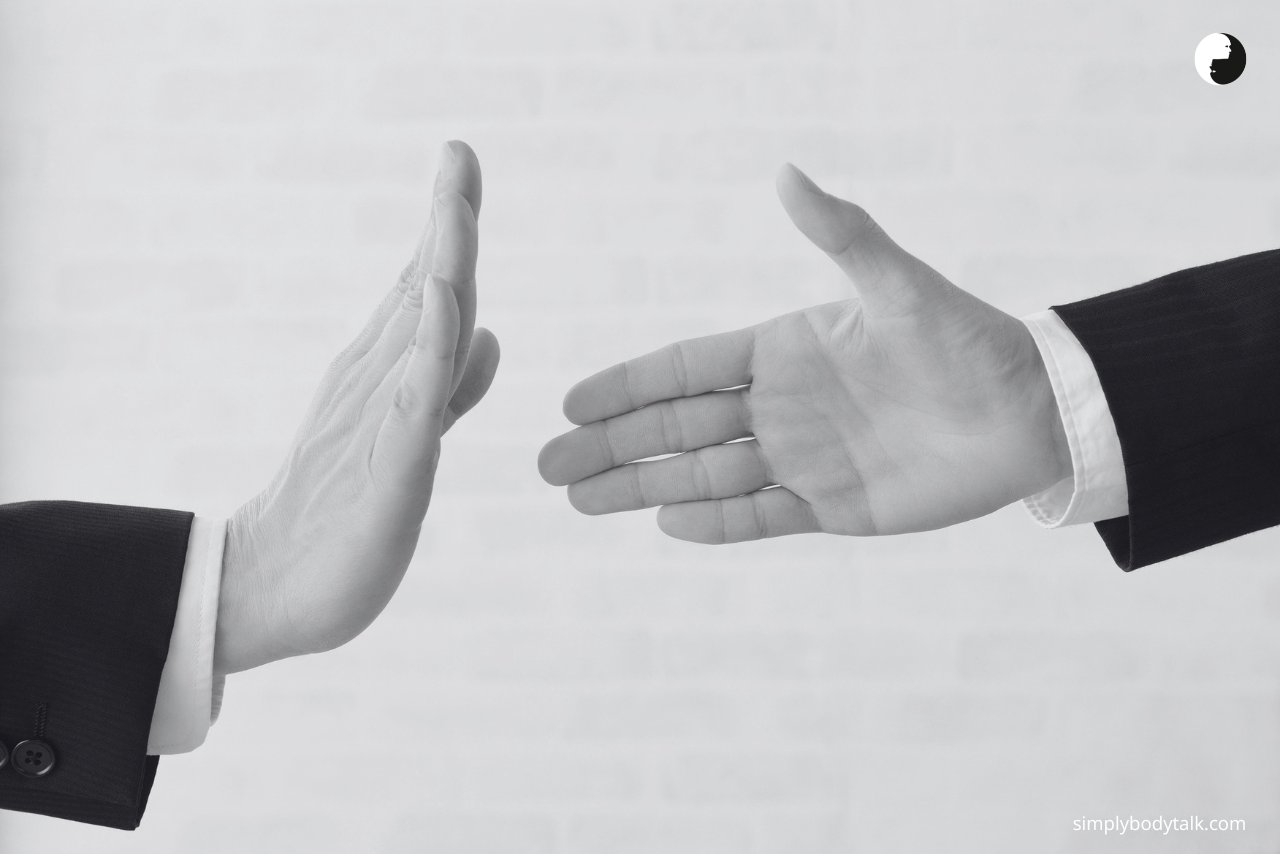
Merely offering fingers rather than the full hand or a limp hand results in an awkward handshake. This might be done by an unwilling female forced into a handshake by a male. Or when the intention to shake hands is not expressed very decisively. Recognizing and avoiding such handshakes can improve nonverbal communication and enhance bonding.
Free Ebook
Interview Tips — Body Language Guide
Appearing for a job interview? While you may have worked on your answers, how you present yourself nonverbally matters just as much. Download our free guide and walk in with confidence.
Download Free EbookHANDSHAKE WITH FEMALES
Most of the time when greeting a person of the opposite sex, it is difficult to judge whether a handshake is acceptable to the female. It is best for the female to offer the hand. A female willing to shake hands shows an openness to try new things. Too soft a handshake by a female is not considered positively by males. If a female is offering you a handshake, match the firmness of her handshake. Like men, they too don’t like clumsy handshakes. This is especially relevant in promoting gender equality in workplace settings and leadership.

HANDSHAKE MISTAKES TO AVOID: COMMON ERRORS AND THEIR IMPACT
Handshakes, while important for establishing connections and leaving positive impressions, can also be susceptible to mistakes that may have a negative impact. It is important to identify common handshake mistakes and their potential consequences in various social and professional settings, including workplaces and leadership contexts.
1. THE WEAK HANDSHAKE
A negative impression can caused by a weak handshake, where the grip lacks firmness and confidence. A weak handshake can convey a lack of assertiveness, professionalism, and undermine the establishment of trust. This is crucial in nonverbal communication and leadership scenarios.
2. THE OVERLY AGGRESSIVE HANDSHAKE
An overly aggressive handshake, where the grip is excessively tight or accompanied by excessive force, can be perceived as domineering, intimidating, or disrespectful, potentially damaging rapport and creating discomfort. Effective leadership requires that we avoid such rooky mistakes.
3. INAPPROPRIATE DURATION
Maintaining an appropriate duration for a handshake is crucial, avoiding both excessively brief and excessively prolonged handshakes. A handshake that is too brief may come across as dismissive, while one that lingers for too long can be interpreted as intrusive or awkward. This balance is essential in workplace interactions and leadership.
4. LACK OF EYE CONTACT
Maintaining eye contact during a handshake is extermely important. We discussed above how a good handshake can help build rapport very quickly with a stranger. That rapport building is strengthened when we also take a step further and maintain good eye contact. Avoiding eye contact can be perceived as disinterest, lack of confidence, or a failure to establish a genuine connection. This is a critical aspect of nonverbal communication in leadership and workplace settings.
5. IGNORING CULTURAL NORMS
Discussing the importance of being mindful of cultural differences and customs related to handshakes. Exploring how ignorance or disregard for cultural norms surrounding handshakes can lead to misunderstandings, discomfort, or offense. Effective leadership and workplace interactions require cultural sensitivity.
6. THE UNSURE EXCHANGE
It is a mistake to use an inappropriate handshake style for the given context. Using a formal handshake in a casual setting or vice versa can create a mismatch and hinder effective communication or rapport-building. This adaptability is crucial in workplace situations where you may be meeting new people daily, especially if you are a leader.
7. THE AWKWARD FUMBLE
When a hand offered is withdrawn too quickly, the other person offering his hand to shake would be left with his hand dangling in air. You would again offer your hand by which time he would have withdrawn, hence leading to the handshake fumble. The best way to avoid this is to hold out you hand only in situations where you are sure the other party is not hostile. In case the person has agreed to meet you rather unwillingly, it is best to nod in greeting and wait for the person to offer a handshake. On neutral grounds, remember to hold out your hand long enough to allow the other person to react. Avoiding such fumbles is essential for effective nonverbal communication and bonding in the workplace.
CONCLUSION
Handshakes are an important part of rapport building when exchanged properly. By understanding the common handshake mistakes, we can become more aware of their actions and strive to avoid them. Doing a little homework when travelling to a new place or checking in with the HR or the co-ordinator about the corporate culture or local custom can be a great help here. Work on improving your handshake etiquette and making a positive impression in social and professional interactions, enhancing your relations with people.
Free Ebook
Body Language Stories — Learn Through Real Life Scenarios
Sometimes the best way to understand body language is through a story. This free ebook walks you through real life situations at work and in personal life — showing how nonverbal communication can make or break the moment.
Download Free EbookOTHER RELATED ARTICLES
HOW WE CAN HELP
Your handshake speaks volumes about your confidence and professionalism. Learn how to avoid common mistakes and make a lasting impact in any meeting. If you are looking to upgrade your body language skills, check out our online pre recorded courses on various topics that come with lifetime access. For customised package on getting your executive presence right, be sure to book a free consultation with us. Contact us for expert guidance at+91 9930941534
FAQ’s
How does a handshake influence leadership perception in professional settings?
A handshake operates as an early behavioural signal. It quietly frames how authority, confidence, and intent are read before any verbal exchange begins. Leaders are often judged on this initial nonverbal cue long before content or competence is assessed.
What does a dominant or submissive handshake signal in workplace interactions?
A dominant handshake can indicate an attempt to control or steer the interaction, while a submissive one may suggest accommodation or reduced resistance. Neither is inherently good or bad, but both shape expectations around decision-making and power balance.
Why do weak or overly aggressive handshakes undermine credibility?
A weak handshake often signals hesitation or lack of conviction, while an aggressive grip can be interpreted as compensatory or intrusive. In senior environments, both create unnecessary noise that distracts from clarity and authority.
How important is eye contact during a handshake for leaders?
Eye contact anchors the gesture. Without it, even a technically correct handshake can feel transactional or disengaged. With it, the same action communicates attention, confidence, and psychological presence.
How should leaders adapt handshakes across cultures and contexts?
Effective leaders read context before applying habit. Cultural norms, hierarchy, and situational tone all influence how a handshake is received. Adaptability here reflects behavioural intelligence rather than inconsistency.






Be sure to answer to the quiz question here