


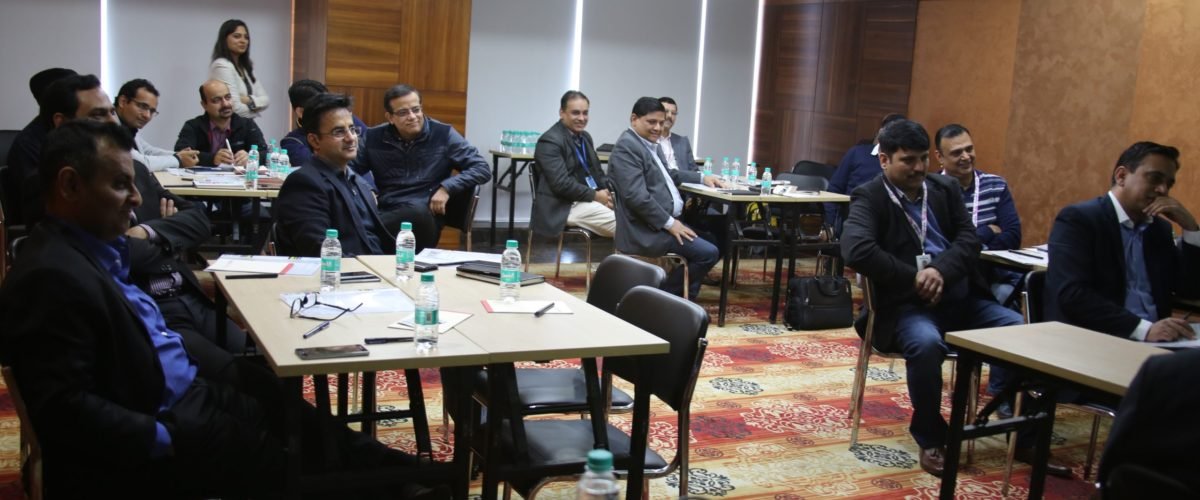
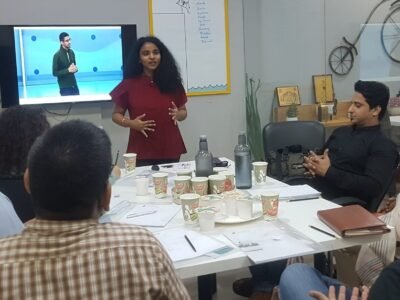
Wish to explore how nonverbal communication can give your leadership teams an advantage through workshops? Select from a wide variety of workshop modules which can be executed in person or online over a short session or longer engagements, as per your requirement and suitability.
Browse our workshop modules
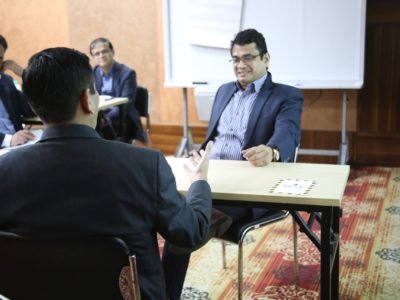
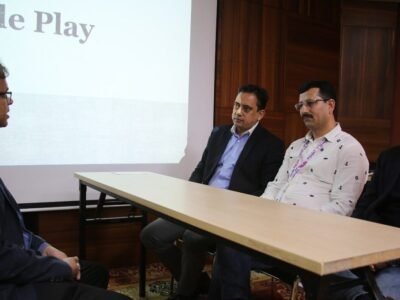




Watch the video to get more Insight

WHAT OUR CLIENTS SAY
Swati Govil Head HR, Carnival Support Service India
Simply Body Talk facilitated the ‘Investing in Self’ module in our Leadership Development program for emerging talent in CSSI. Topics covered included self-awareness, Emotional Intelligence, and Self-development.
The activities, role-plays, and videos are well-integrated with the conceptual base of each topic. Looking forward to the association for our future interventions.
Priya Ekka
Talent Engagement, TALA
The session on Body Language for Business was a very insightful and engaging session! Some excellent tips and suggestions were shared during the session. The learning went really well with all the examples and activities.

Sheeba Varghese
HR & Admin Dept.
Sacmi Engineering (India) Pvt. Ltd
“The session for our senior staff was indeed quite interactive, it was customized and designed, understanding our need for improvement in communication. The most impressive part was the nonverbal communication highlighted through various body languages, which usually was ignored by many of us.
The session definitely helped us in understanding different perspectives of communication and which in turn not only facilitated all attendees improve their communication professionally but also strengthen their interpersonal relationships.
Thanking you Ms. Khyati for showcasing the strength of Body language in a Simple way through Simply Body Talk”

Dr. Shardul Kaneria
Owner,
Kiddie Academy of Herriman
We worked with Simply Body Talk with an intention for our early childhood educators and our leadership team to learn about the nuances of body language and non-verbal communication when working with our children, our parents and each other. We got more out of the session than we had hoped for. The knowledge, the skills and the techniques we learnt through this session are reaping benefits already when it comes to people management at our academy. Thank you so much Simply Body Talk for the simply mind-blowing session and we can’t wait to work with you again in the future.

Majnoo Gawture
L&D Head, Danfoss India
The trainer was able to tailor the training to our needs, with relevant slides, case studies and role plays. Not only was she very professional, but also friendly and created instant rapport with participants. Her expertise on Body Language was very much helpful to all the managers attending the session. This session has enhanced my skills further along with new networks that I formed during the session. Thanks to Simply Body Talk.

Sumedha Awasthy
Program Associate, India Program CLASP
Thank you for such an excellent training session. I never thought it would be this impactful. The discussion was filled with so much knowledge and we all learned many new things about non-verbal communication. Looking forward to more such collaborations between Simply Body Talk and Clasp.
Get a callback
FAqS
Can workshops be conducted for cross-functional teams?
Yes. The primary requirement is a clearly defined objective for the engagement. From our experience, cross-functional teams often benefit from attending together, especially when the same process is followed with slight role-based variations. This allows participants to learn from one another’s perspectives during the session.
However, we recommend keeping participants within a similar level of hierarchy so they can engage openly and participate without hesitation or fear of judgement from senior leaders.
Do participants need prior training or knowledge to attend these workshops?
No prior training is required. Our workshops are designed to meet participants at their current level, irrespective of previous exposure to communication, leadership, or behavioural training. Concepts are introduced in a structured manner and applied directly to real workplace situations relevant to participants’ roles.
Can workshops be customised based on our organisation’s challenges?
Absolutely. Every organisation, team, and role comes with its own challenges. Workshops are customised based on your organisation’s context, objectives, and specific pain points. We begin by understanding your expectations and focus areas, and then tailor the content, examples, and activities to ensure relevance and practical application.
How is body language integrated into your workshops?
Relevant body language concepts are selected and addressed based on the learning objectives of the engagement. Any misconceptions or blind spots identified during the pre-assessment are clarified during the workshop. During role plays and activities, the trainer provides live inputs so participants can observe how these concepts play out in real time. The integration of body language is always tailored to the specific team and challenges being addressed.
How do you measure the effectiveness of your corporate training program?
The effectiveness of our engagements is measured by comparing pre- and post-assessments aligned with defined objectives. This is supported by performance during activities, quality of participation, and application of learning to real work scenarios. Depending on the engagement, this may also include participant feedback, key takeaways shared during sessions, and inputs from HR or reporting leaders on observed behavioural changes over time.
Can workshops be extended into coaching or long-term development programs?
Yes. Workshops often serve as a starting point for deeper development. Based on the needs of the participating group, engagements can be extended into group coaching for managers, individual coaching for leaders, consulting support for HR on process improvements, or organisation-wide communication initiatives aligned with expected values and behaviours.
How do HR and business leaders get visibility into progress and outcomes?
Finalised objectives are shared after the pre-assessment is completed. Upon completion of the training and follow-up sessions, we provide detailed trainer inputs covering expected versus delivered objectives, activities that created the most value for participants, post-assessment outcomes, and recommended next steps for the group.
What is the batch size required for your workshops?
For managerial-level workshops, the ideal batch size is 20-25 participants. This allows sufficient interaction during role plays and activities, exposure to different perspectives, and peer learning. For senior leadership teams, we typically work with smaller groups of around 8-10 participants to enable deeper discussions, strategic thinking, and focused problem-solving.